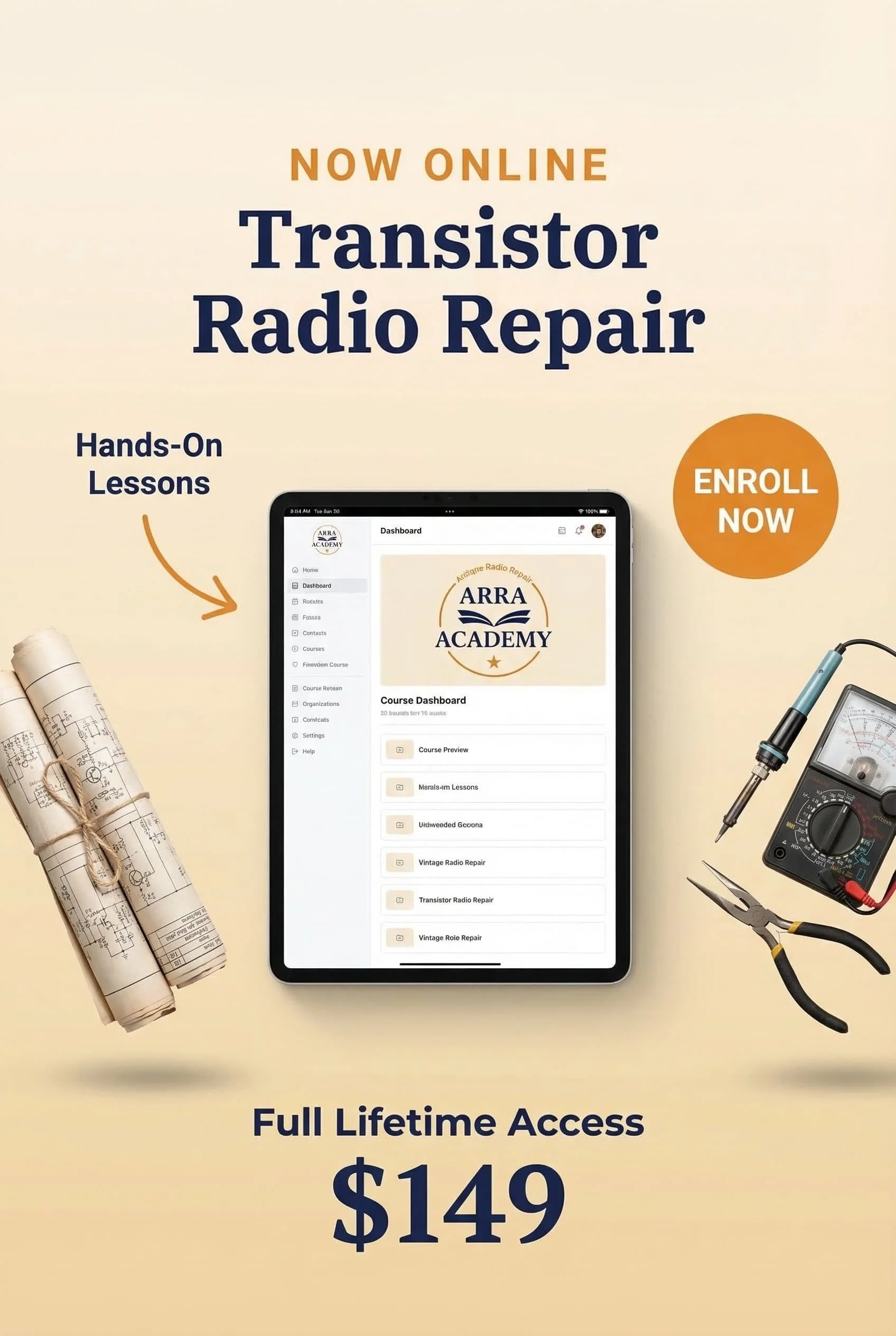



This Transistor Radio Repair Course guides new hobbyists and tech pros how to understand and repair vintage transistor radios. You spot these treasures for low prices on eBay or Facebook Marketplace. They often appear in bulk lots, ready for revival.
People have used this trusted program and its key books for years. Lessons draw from the peak era of transistor radios in the 1950s and 1960s. These small devices fit in pockets. They brought music and news anywhere. Battery power made them free from outlets, unlike bulky tube radios that needed wall plugs and took up space.
The course now includes new tools. Short online videos show real steps. Quick quizzes check your grasp of key points.
Your goal may be one radio or a whole collection. The course delivers core facts, clear repair steps, and basic tools. You learn to find faults like failed capacitors or faint speakers. Capacitors hold electric charge but dry out over time. Speakers lose strength from dust or wear. Use a simple multimeter to test parts. It measures voltage, current, and resistance. Restore that rich, warm sound from the past.
Each module, in the Transistor Radio Repair Course, packs dense content. It has full lessons, an exam, video demos, a podcast, and a quiz. Videos capture live repairs on classics like the Regency TR-1, the first transistor radio from 1954, or the Zenith Trans-Oceanic, a rugged shortwave model. See a pro replace a burned resistor step by step. Resistors control current flow and crack with age. Podcasts explain processes for your drive or walk. Quizzes follow right away to seal the knowledge in How To Repair Transistor Radios.
Theory stays basic. It aids repairs without heavy math. Hands-on fixes lead the way. Trace a no-sound issue from antenna to speaker cone. Start at the antenna wire. Check each solder joint. Test the volume pot for dirt. Move to the output transformer.
You gain the most with some radio basics. No experience? Start with simple electronics reviews. Learn how radio signals travel through circuits as waves. Transistors replaced tubes. Tubes heat up with filaments. Transistors run cool and fast on solid-state parts. Pick up a basic book on Ohm's law, which links voltage, current, and resistance. Or one on amplifiers, which boost weak signals to drive speakers. This builds a firm base.
Common questions arise. How long per module? Plan one to two hours. Need parts? Source them from radio shops or online. Tools list stays cheap: soldering iron, pliers, meter. Safety first—unplug batteries. Discharge caps to avoid shocks.
Millions of these radios sold back then. By 1960, they filled pockets worldwide. Fix one, and you link to that boom time. The course teaches you how to fix or repair Transistor Radios allowing you to turn junk into jewels.
With The ARRA Transistor Radio Repair Course
Learn How To Repair Vintage Transistor Radios
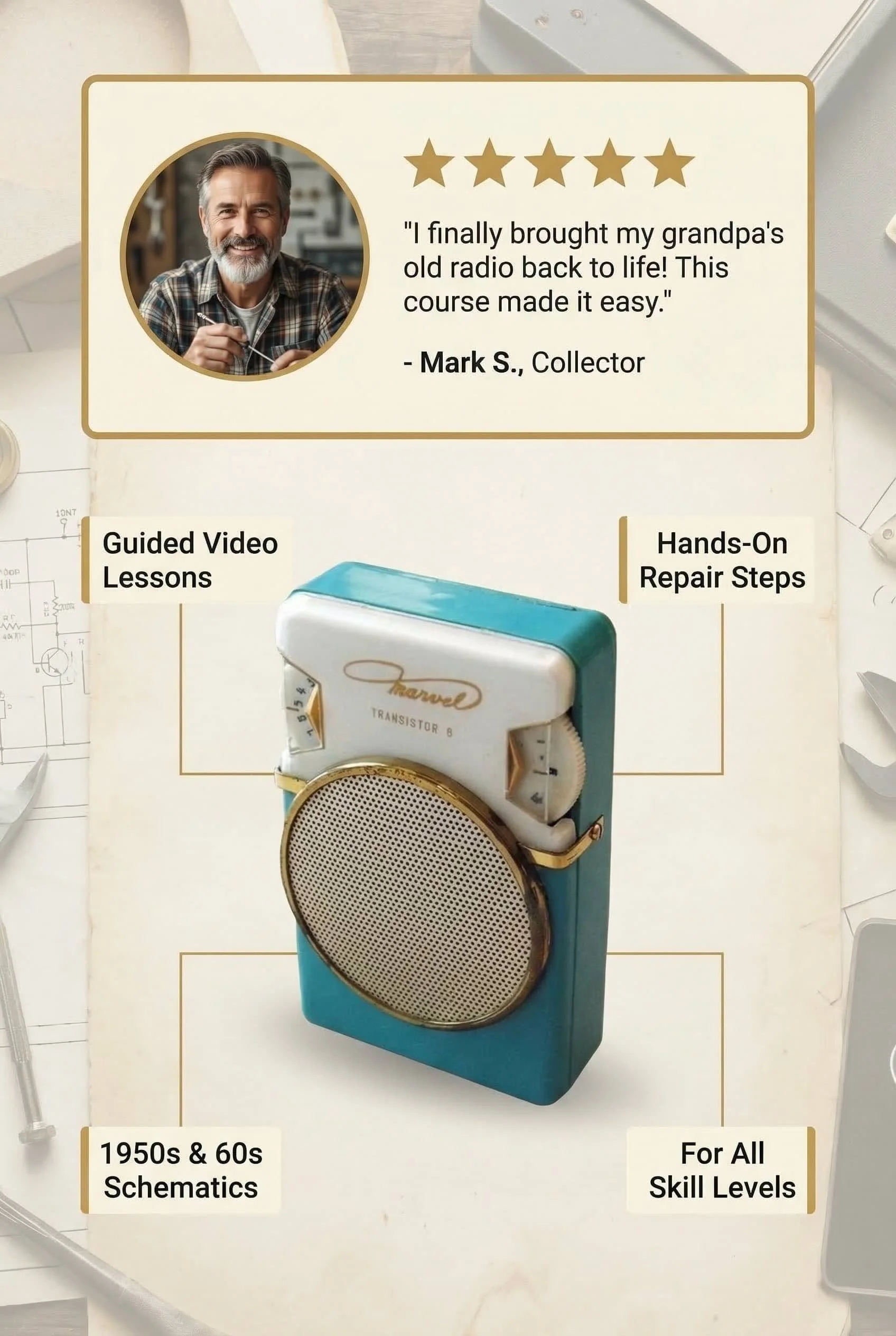
“I am a fulltime Respiratory tech student. I have finshed about ½ of this course which has has allowed me to make some supplemental cash on weeknights/weekends. ”
Jeremy Branes RRT student “Excellent learning format. I had a little electronics experience but was able to leverage the tools available and have now repaired a number of these old gems ”
Brian D retired “I listened to the podcasts on my commute to work and found myself retaining the concepts easily with this technique. Great course! ”
Marshal r Firefighter